
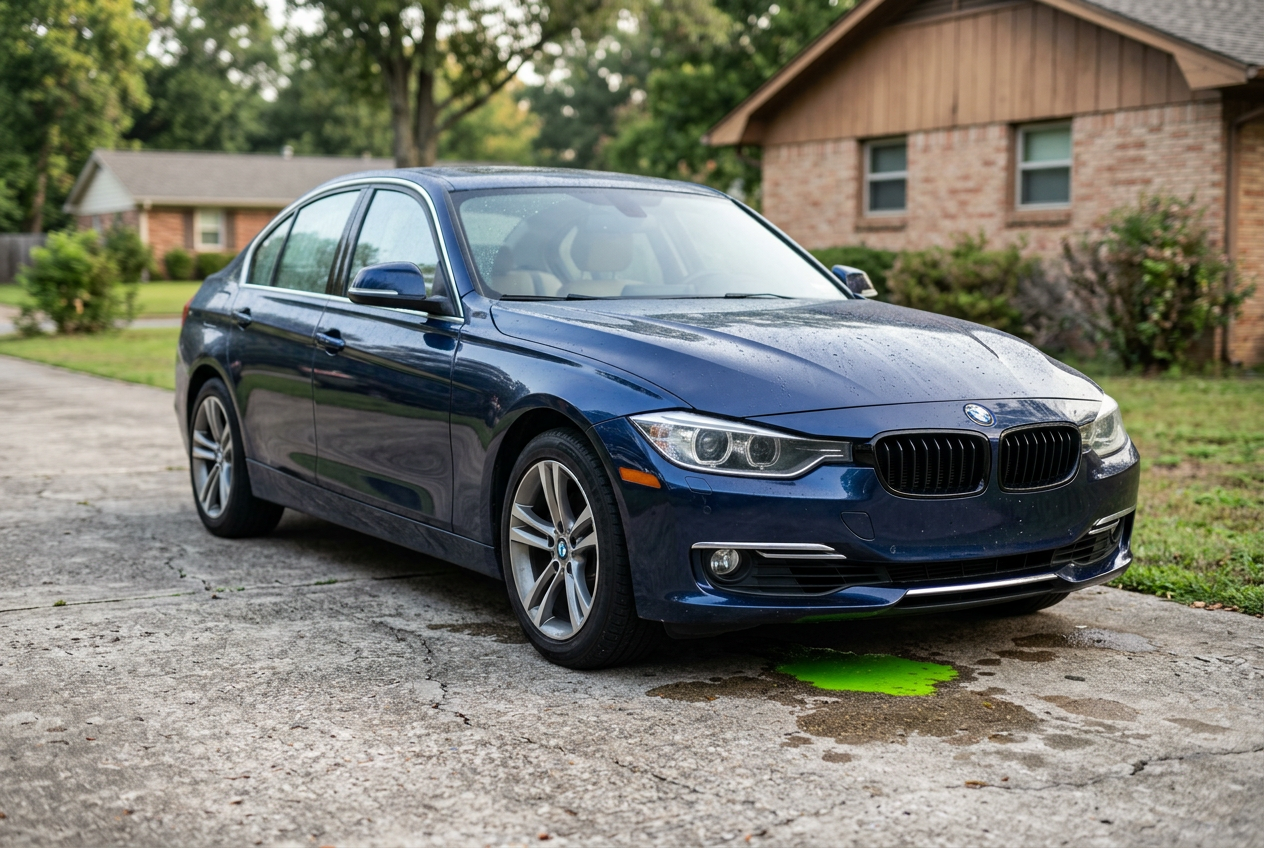
A coolant leak on a BMW 330i, 540i, X3, or any B46, B48, or B58-powered model is most often caused by a cracked or brittle plastic coolant outlet, expansion tank, or vent hose. These plastic components are built into the cooling system from the factory and they become fragile over time, especially under the heat cycles a turbocharged engine produces. The result is coolant loss, a sweet smell from the engine bay, and eventually an overheating warning if the leak goes unaddressed. The good news is that catching it early means a straightforward repair before it becomes an engine problem.
Which BMW Models Are Affected?
This is a known pattern on BMW’s B46, B48, and B58 engine families built from 2016 onward. The affected US-market models include:
- 230i and M240i (B46/B48/B58)
- 330i and M340i (B48/B58)
- 430i and 840i (B48/B58)
- 530i and 540i (B48/B58)
- 740i (B58)
- X1 xDrive28i and X2 xDrive28i (B48)
- X3 xDrive30i and X3 M40i (B48/B58)
- X4 M40i (B58)
- X5 xDrive40i and X7 xDrive40i (B58)
- Z4 sDrive30i and Z4 M40i (B48/B58)
If your BMW uses one of these engines and it was built in 2016 or later, the plastic cooling components are worth watching.
What Exactly Is Leaking?
The B46, B48, and B58 engines use several plastic components in the cooling circuit. The most common failure points are the coolant outlet housing (sometimes called the coolant flange), the plastic expansion tank, and the small vent or bleed hoses that connect to it. These parts are made of glass-filled nylon and similar materials that hold up well when new. Over years of heat cycling, the plastic becomes brittle, cracks at seams, or fails where it meets a rubber hose or metal fitting.
What Are the Symptoms, and How Do They Progress?
The leak usually starts small and gets worse over time. Here is how it typically develops:
| Stage | What You Notice | Likely Cause | Urgency |
|---|---|---|---|
| Early | Sweet smell from engine bay, coolant level drops slowly | Small crack in plastic outlet or vent hose | Schedule soon |
| Mid | Low coolant warning light, white residue near hose connections | Expansion tank seam or outlet housing leaking under pressure | Schedule this week |
| Late | Temperature gauge rising, steam from engine bay, heater blowing cold | Significant coolant loss, possible air in system | Stop driving now |
Is It Safe to Keep Driving?
A slow, early-stage leak gives you a short window to get it diagnosed. If the coolant level is just slightly low and the temperature gauge is normal, you can drive carefully to a shop. Top off the coolant with the correct BMW-spec coolant first, not water alone. If the temperature gauge moves above its normal position, or if the low-coolant warning comes on while you are driving, pull over and stop. Continuing to drive an overheating BMW engine can warp the cylinder head, which turns a few hundred dollars of plastic parts into a repair that costs several times more.
Why Do These Plastic Parts Fail?
Heat is the main factor. Turbocharged engines like the B48 and B58 run hot and cycle through wide temperature swings every time you start and stop the car. Plastic components expand and contract with each cycle. Over 50,000 to 80,000 miles, that repeated stress causes micro-cracks that eventually open up under pressure. Oklahoma summers add to the problem. The intense UV and heat here degrade rubber hoses and plastic components faster than owners expect. A hose that looks fine to the eye can already be stiff and brittle on the inside.

How Is the Repair Done?
The standard procedure starts with a cooling system pressure test to confirm where the leak is and whether there are multiple leak points. Once the failed component is identified, the system is drained, the part is replaced with a new unit (OEM or quality aftermarket), and the system is refilled with the correct BMW-spec coolant. After the fill, the system is bled to remove air pockets, then pressure-tested again to confirm the repair is complete. On B48 and B58 engines, the coolant outlet housing sits at the rear of the engine block, which means some disassembly is required to reach it. Labor time varies by model.
What Does It Cost to Fix?
The cost depends on which component is leaking and how accessible it is on your specific model. A vent hose or small plastic fitting is a lower-cost repair. The coolant outlet housing or a pressurized expansion tank involves more labor, especially on models where the part is tucked behind other components. What moves the price:
- Which part is leaking (outlet housing vs. expansion tank vs. vent hose)
- Whether multiple components need replacement at the same time
- Model and engine variant (labor access differs between, say, an X5 xDrive40i and a 330i)
- Whether the system needs a full coolant flush and refill or just a top-off after the repair
A pressure test first gives you a clear picture of what needs to be done and what it will cost before any work starts. There is no honest single number without seeing the car.
Is There a Recall on This Issue?
No confirmed recall covers this plastic coolant component failure pattern as of this writing. It is a known issue on B46, B48, and B58 engines, but BMW has not issued a recall or special coverage program for it. You can check your VIN at nhtsa.gov/recalls to confirm nothing has changed for your specific car. The BMW USA owners portal is also worth checking for any active service campaigns tied to your VIN.
Why Fix It at an Independent European Specialist?
VAP Auto Shop on East 40th Street has specialized in European and import vehicles since 2005. The shop works exclusively on European makes, which means the technicians here know the B48 and B58 cooling systems the way a general shop knows oil changes. VAP uses quality brands including Bosch, Liqui-Moly, and BG Products, and the shop is ASE certified. For drivers coming off the BA or through Mingo Valley every day, having a shop that knows your car specifically is worth the trip. Learn more about BMW repair at VAP Auto Shop, or see the areas we serve across Tulsa.
If you are in Lacy Park, Kendall-Whittier, or the Gilcrease Hills area, VAP is your closest European specialist. See the Lacy Park service page or the Gilcrease Hills page for directions and details. You may also find the post on why BMW X5 models burn oil useful if your car has more than one issue showing up at once.
Frequently Asked Questions
Can I keep driving my BMW if it is losing coolant?
Not for long. A slow drip gives you a short window to get it checked, but if the temperature gauge climbs or the low-coolant warning lights up, stop driving and call for a tow. Overheating a BMW engine is an expensive mistake.
Which BMW models are affected by this plastic coolant leak issue?
It is most common on B46, B48, and B58 engine families from 2016 onward, including the 230i, 330i, 430i, 530i, 540i, 740i, 840i, M240i, M340i, X1 xDrive28i, X2 xDrive28i, X3 xDrive30i, X3 M40i, X4 M40i, X5 xDrive40i, X7 xDrive40i, Z4 sDrive30i, and Z4 M40i.
Is this a recall?
No confirmed recall covers this issue as of this writing. It is a known pattern on these engines, and the repair is an out-of-pocket service. Check nhtsa.gov/recalls with your VIN to confirm nothing has changed for your specific car.
How much does it cost to fix a BMW plastic coolant leak?
The price depends on which component is leaking. A single plastic outlet or vent hose costs less than a full cooling system overhaul. Labor time varies by how accessible the part is. A pressure test first tells you exactly what needs replacing.
How do I know if my coolant is leaking from a plastic part or something else?
A pressure test is the reliable way to find it. Visible white residue or a sweet smell near the engine bay are common signs. Plastic outlet leaks often appear at the seam where the plastic meets a rubber hose or a metal fitting.
Smell coolant or see the low-coolant warning on your BMW? Travis Vreeland, owner and ASE Certified technician at VAP Auto Shop, and the VAP team will pressure-test your cooling system, find the leak, and give you a straight answer on what it costs to fix.
Call us: (918) 398-6670 | Schedule online
VAP Auto Shop • 6549 E 40th St #10, Tulsa, OK • Monday-Friday 8am-5pm
